
Supply Chain Management vs. Procurement: What’s the Difference?
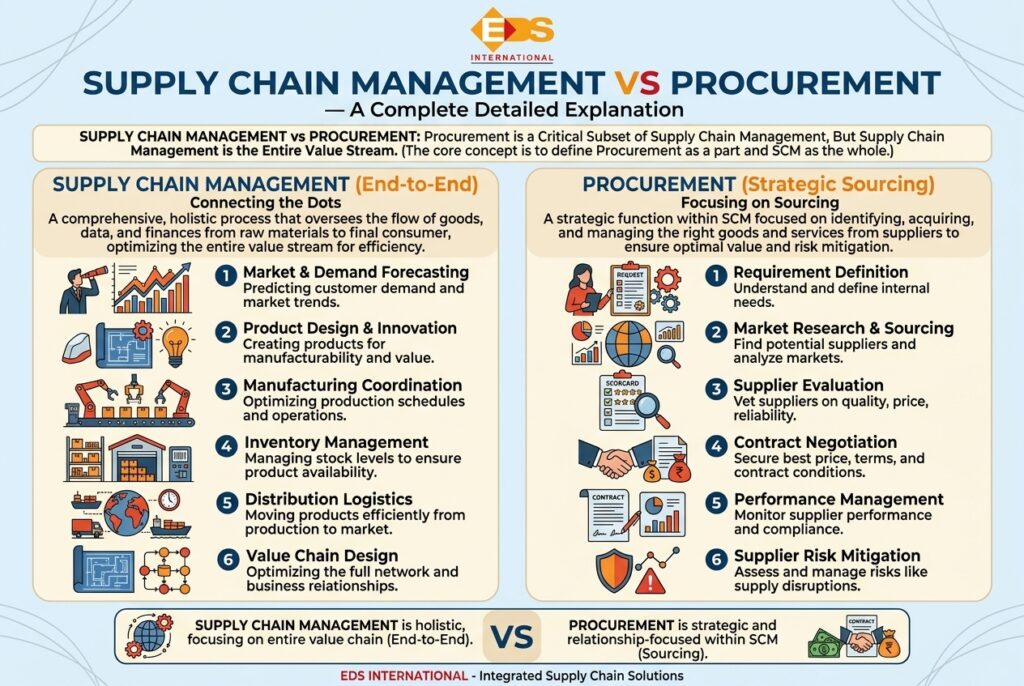
Procurement and supply chain management are closely connected, but they are not the same thing.
Procurement is one part of supply chain management. Supply chain management takes a broader view of how materials, products, information, and services move from suppliers through production and ultimately to the customer.
Understanding the difference is especially important for manufacturers managing suppliers across multiple countries.
What Is Procurement?
Procurement is the process of obtaining the goods and services a company needs from external suppliers.
It typically includes:
- Identifying suppliers
- Requesting and comparing quotations
- Negotiating prices and terms
- Selecting suppliers
- Managing contracts
- Issuing purchase orders
- Monitoring supplier performance
Procurement therefore focuses heavily on the purchasing process and supplier relationship.
Strategic procurement can go beyond price and include supplier development, cost analysis, supplier diversification, and long-term sourcing strategies.
What Is Supply Chain Management?
Supply Chain Management (SCM) covers the broader flow of goods and activities across the supply chain.
Depending on the organization, this can include:
- Supplier identification and qualification
- Sourcing and procurement
- Supplier management
- Production follow-up
- Quality control
- Inventory coordination
- Transportation and logistics
- Shipment tracking
- Delivery management
- Supply chain risk management
In simple terms, procurement focuses on acquiring what the company needs, while supply chain management focuses on coordinating the entire process of getting it from source to destination.
Supply Chain Management vs. Procurement
The easiest way to see the difference is by looking at their scope.
| Procurement | Supply Chain Management |
|---|---|
| Focuses on purchasing | Focuses on the entire supply chain |
| Finds and selects suppliers | Coordinates suppliers and supply chain activities |
| Negotiates prices and terms | Manages the broader flow of goods and information |
| Issues purchase orders | Follows orders through production and delivery |
| Focuses heavily on purchasing costs | Considers cost, quality, delivery, risk, and continuity |
The functions should not operate independently. Procurement decisions directly affect production, inventory, logistics, quality, and ultimately the customer’s experience.
Where Does Sourcing Fit?
Sourcing is another term often confused with procurement.
Sourcing generally focuses on identifying, evaluating, and selecting suppliers. It can include market research, supplier qualification, RFQs, capability assessments, and negotiations.
A simplified way to view the relationship is:
Supply Chain Management → Procurement → Sourcing → Supplier Selection
The exact responsibilities vary between organizations, but sourcing and procurement are both components of the broader supply chain.
Why Procurement Alone May Not Be Enough
A supplier can offer an attractive price and still create supply chain problems.
For example, a supplier may have:
- Long production lead times
- Inconsistent quality
- Limited capacity
- Poor communication
- Frequent shipment delays
- High minimum order quantities
This is why manufacturers need to consider more than the purchase price.
A broader Total Cost of Ownership (TCO) approach considers factors such as transportation, quality issues, inventory, lead times, and other costs associated with the supplier relationship.
Once a purchase order is placed, someone still needs to communicate with the supplier, monitor production, coordinate quality inspections, address issues, and manage the shipment.
That is where supply chain management extends beyond procurement.
Supplier Management Is Part of the Bigger Picture
Supplier management connects procurement with the ongoing operation of the supply chain.
After a supplier is selected, companies may need to:
- Monitor production
- Track delivery performance
- Address quality issues
- Review supplier capacity
- Manage corrective actions
- Maintain regular communication
- Develop alternative suppliers when necessary
This can become more challenging when suppliers are located overseas.
Language barriers, time zones, geographic distance, and different business practices can make local supplier presence valuable. Having people on the ground who can communicate with manufacturers and visit suppliers when needed can improve visibility and responsiveness.
For manufacturers managing international suppliers, EDS also provides resources on [managing global logistics and supply chains] and supplier performance.
Why the Difference Matters for Global Manufacturers
Global sourcing creates opportunities, but it also adds coordination requirements.
A manufacturer may successfully identify and negotiate with a supplier in China, India, Vietnam, Thailand, or Mexico. But supplier selection is only the beginning.
The company still needs to manage:
Supplier → Purchase Order → Production → Quality → Shipment → Delivery
Procurement is involved throughout this process, but end-to-end supply chain management connects these activities together.
This can be particularly valuable for companies that do not have their own teams in every sourcing market.
Should You Outsource Supply Chain Management?
Outsourcing does not necessarily mean giving up control.
Many manufacturers keep strategic procurement and supply chain decisions internally while using an external partner for operational support.
An external partner can provide additional resources for:
- Supplier identification and qualification
- RFQs and procurement
- Supplier communication
- Production follow-up
- Quality coordination
- Order management
- Logistics coordination
- Supplier performance monitoring
- Local supplier visits
This approach can give internal teams additional capacity and local expertise without requiring the company to build a full operation in every manufacturing market.
Procurement Is Part of Supply Chain Management
Procurement and supply chain management should not be viewed as competing functions.
Procurement focuses on acquiring goods and services. Supply chain management coordinates the broader process that gets those goods from supplier to destination.
For manufacturers, the distinction is important because a successful supply chain depends on much more than negotiating a competitive purchase price.
Supplier selection, production, quality, communication, logistics, and delivery all influence whether the supply chain actually performs as expected.
How EDS Supports End-to-End Supply Chain Management
EDS International supports manufacturers across multiple stages of the supply chain, from supplier identification and procurement through production management, quality coordination, and logistics.
With teams on the ground in key manufacturing markets, EDS can help companies:
- Identify and qualify suppliers
- Manage RFQs and procurement
- Communicate directly with manufacturers
- Follow up on production and orders
- Coordinate quality inspections
- Monitor supplier performance
- Coordinate logistics and shipments
- Support supply chain diversification
EDS can work as an extension of your procurement or supply chain team, providing local execution and supplier coordination where additional resources are needed.
If your company needs more than procurement support, EDS can help manage the broader supply chain with end-to-end supply chain management services—from supplier identification and procurement through production, quality, and logistics.